

Food gelatin
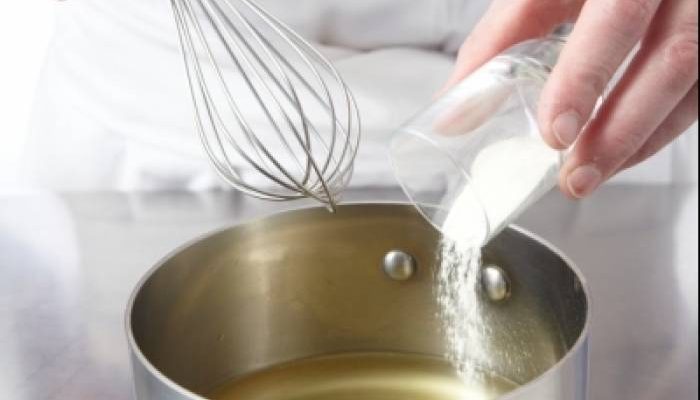
Powdered gelatin is the only type that is kosher. Powdered gelatin is dissolved in cold water, then stirred into a hot liquid before being allowed to cool. Its advantage? Precision! Use 10g of powder to dissolve in 50g of water.
Note that some raw foods containing proteolytic enzymes prevent gelling (pineapple, kiwi, papaya, guava, figs, melon, ginger, etc.). However, once cooked, these foods no longer pose a problem.
Demolding tip: dip your mold in very hot water for a few seconds.
Agar agar
Agar-agar is a natural, plant-based gelling agent extracted from a red algae (Gracilaria or Gelidium). It is available in fiber or white powder form. This natural gelling agent sets quickly (as soon as the temperature drops below 40°C) and easily replaces gelatin, without adding any flavor to food, and the result is surprising!
To get a less brittle jelly, you can reduce the agar agar a little and add arrowroot.
Note that desserts made with agar-agar do not withstand freezing.
Easy unmolding tip: Grease your molds before pouring in your mixture. When unmolding, run a thin knife blade between the sides to loosen the molds slightly.
Pectin
Pectin is a plant-based substance found in many fruit seeds (apples, quince, currants, etc.) and citrus peels. It plays a structural role by retaining water and gelling preparations. Primarily used for making jams, it can also gel fruit-based desserts.
Commercially available pectin is mostly extracted from dried apple or quince pomace. It is most often found in crystalline form, like powder. (The European Union authorizes the use of pectin as a food texturizer, under the number E440.)
How to cook with gelatin, pectin and agar?
Agar-agar: A cold start
Agar-agar is incorporated into a cold liquid. It dissolves very well without forming lumps, but you can first mix it with sugar to improve its dissolution. Bring the liquid to a boil and let it simmer for 30 seconds. The mixture will gel as it cools.
Unaffected by pH or degradation by acids or enzymes, this gelling agent is perfect for making jellies, mousses, or even coulis. Simply adjust the concentration of gelling agent according to the desired consistency.
Pectin: mix it with sugar and add an acid
It is advisable to thoroughly mix pectin with sugar before adding it to a recipe, to ensure better incorporation. Pectin will only gel in the presence of an acid: this is why adding lemon juice to jams is often recommended.
How do you dose the gelling agents?
How much gelatin should I use?
Powdered gelatin is dissolved in cold water, then added to a hot liquid before being allowed to cool. Dissolve it in a volume of water equal to 5 times its weight (1g of gelatin in 5g of water). Use 10g of powder to dissolve in 50g of water.
How much agar should I use?
Use 4g of agar-agar per liter of liquid. Sometimes 1 to 2g of agar-agar is used, which is difficult to weigh with a standard scale. I recommend using a spoon scale with a precision of 0.1g.
How much pectin should you add to your jams?
Count:
– 15g of pectin per 1kg of fruit and 1kg of sugar to make jam
– 20 to 30 g per 1 kg of fruit paste
– 20 to 30 g of pectin per 1 kg of juice and 700 g of sugar to make jellies
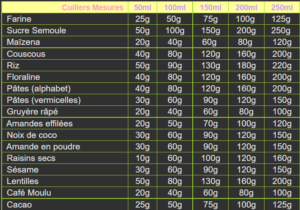
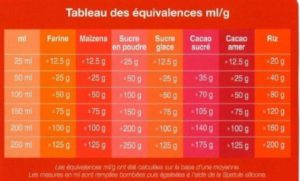
A cup corresponds to 250 ml when I mention "cup" in my recipes. Here are two tables that will help you with your conversions if you don't have a cup!
Find all our recipes in just one click!
Yule Log Recipes Dessert recipes Birthday cake recipes Halavi cake recipes Breakfast cake recipes Cookie recipes Recipes for oriental cakes Quick recipes Pie recipes Cooking recipes
No comments yet.