


Professional croissant dough (or pain au chocolat)
For the dough:
300g of flour (with at least 12.% of protein)
80 grams of water
85 grams of milk
15g of fresh yeast (or 6g of dried yeast)
45 grams of sugar
40g of softened butter
7 grams of salt
Butter for folding the dough: 130g of high-quality European or dry butter *
* THE dry butter (or pastry butter) It is called this because of its lower water content. In fact, it contains more fat (84 %) and therefore makes it easier to make puff pastry. It has a higher melting point. that THE butter classic, which makes it easier to handle at room temperature.
Preparation :
Preparation of the initial dough:
In the bowl of a stand mixer, combine all ingredients except the softened butter. Mix on low-medium speed for about 3-4 minutes until a dough forms. Add the butter and continue mixing on medium speed until you have a smooth, homogeneous, and elastic dough. (You can take a piece of dough and see that it stretches and doesn't tear easily.) .
Wrap the dough in cling film and refrigerate overnight.
Before folding, you should know this:
Note that the butter must be at an exact temperature of 48 degrees Celsius (118 degrees Fahrenheit), supple and elastic, but not too soft and not too hard. It's important to remember that if the butter is too cold, it will break down inside the layers of pastry, and if it's too soft, it will be absorbed by the pastry. Place the rectangle of butter in the center of the pastry, carefully remove the parchment paper, wrap the pastry around the butter, and seal the edges.
Folding the dough (see photo):
Roll out the dough into a nice rectangle:
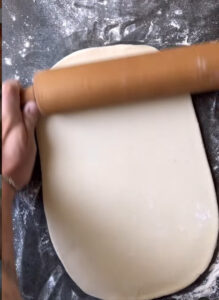
Cut and spread the butter into a rectangle using parchment paper.



Place the rectangle of butter, which should be smaller than the size of the croissant dough.
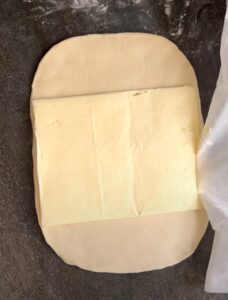
Place the butter and then trim the two sides of the dough that extend beyond the edge.
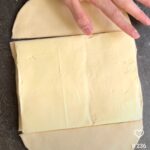

Place the two pieces of dough on top and, using a rolling pin, spread the butter until it is spread throughout the rectangle, cutting off all the ends; it is important that the rectangle is of uniform size.
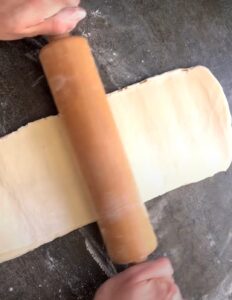
Keep folding the dough lengthwise, but 3/4 on one side and 1/4 on the other, fold it in half again (50/50), and roll it out again, and you get a 4-layer dough.



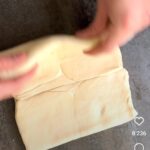

Second folding: * Immediately after completing the first fold, proceed with the second fold, but first, turn the dough so that the fold faces to the side, flour the dough, and fold both ends towards the center, then fold them over themselves (like a wallet). The folding step is complete. Wrap the dough in cling film and refrigerate for at least 3 hours and up to 24 hours.
Shaping :
Remove the chilled dough from the refrigerator and let it rest at room temperature for 5 minutes. Fold the dough over and roll it out into a rectangle 0.5 cm thick. It's important to ensure the dough doesn't stick to the surface, as this could damage the butter layers. Using a sharp knife, cut the dough into triangles 8 cm long and 32 cm wide. Take one triangle of dough, fold and seal the base well, and roll the triangle up to the edge. It's important to stretch and tighten the triangle throughout the rolling process. Repeat this process to form all the remaining triangles into a crescent shape. .
It's important to maintain a rising temperature of 26-28 degrees Celsius; an environment that's too warm will cause the butter layers in the dough to melt. You can place a bowl of warm water on the bottom rack of the oven to create a rising chamber, but it's crucial to use a thermometer to ensure you don't exceed the desired temperature.
Arrange the croissants at wide intervals and let them rise for an hour and a half – they should double in size and jiggle when you move the tray. Preheat the oven to 200 degrees Celsius (390 degrees Fahrenheit) using the turbo setting. Once the oven is hot, place the croissants inside and immediately reduce the temperature to 170 degrees Celsius (340 degrees Fahrenheit). Bake for approximately 20 to 25 minutes, until golden brown. Remove from the oven and let cool to room temperature. .
Additional highlights:
There are no shortcuts to making croissants; every step and every ingredient is essential to success! It takes time and a lot of patience, but in the end, every moment is worth it.
It's important to work at very low temperatures! During summer days, it's difficult to roll the dough manually and keep it cool, so it's important to keep the workshop as cool as possible!
If the dough gets too warm, put it in the freezer for 40 minutes.
High-quality butter with a high percentage of fat (at least 82 %) will make the dough easier to work with and more elastic for the folding stage.
The dough must be handled gently. Applying unnecessary force can break the butter and overheat the dough.
Too high a temperature will ruin all your hard work, the butter will melt and all the layers will be destroyed.




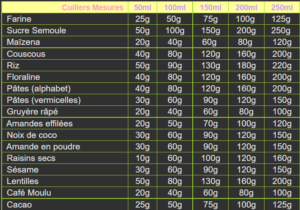
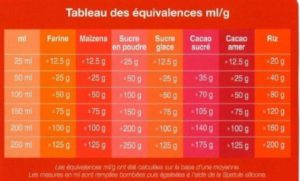
A cup corresponds to 250 ml when I mention "cup" in my recipes. Here are two tables that will help you with your conversions if you don't have a cup!
Find all our recipes in just one click!
Yule Log Recipes Dessert recipes Birthday cake recipes Halavi cake recipes Breakfast cake recipes Cookie recipes Recipes for oriental cakes Quick recipes Pie recipes Cooking recipes











Rate this recipe
0 People Rated This Recipe
Average Rating
No comments yet.